
Sub-Zero guide · 5 min read
Keeping a Sub-Zero wine unit honest in a coastal Santa Cruz cottage
A wine column has to hold steady humidity and temperature against the Monterey Bay marine layer. What that means for Sub-Zero wine storage in Westside and Capitola homes.
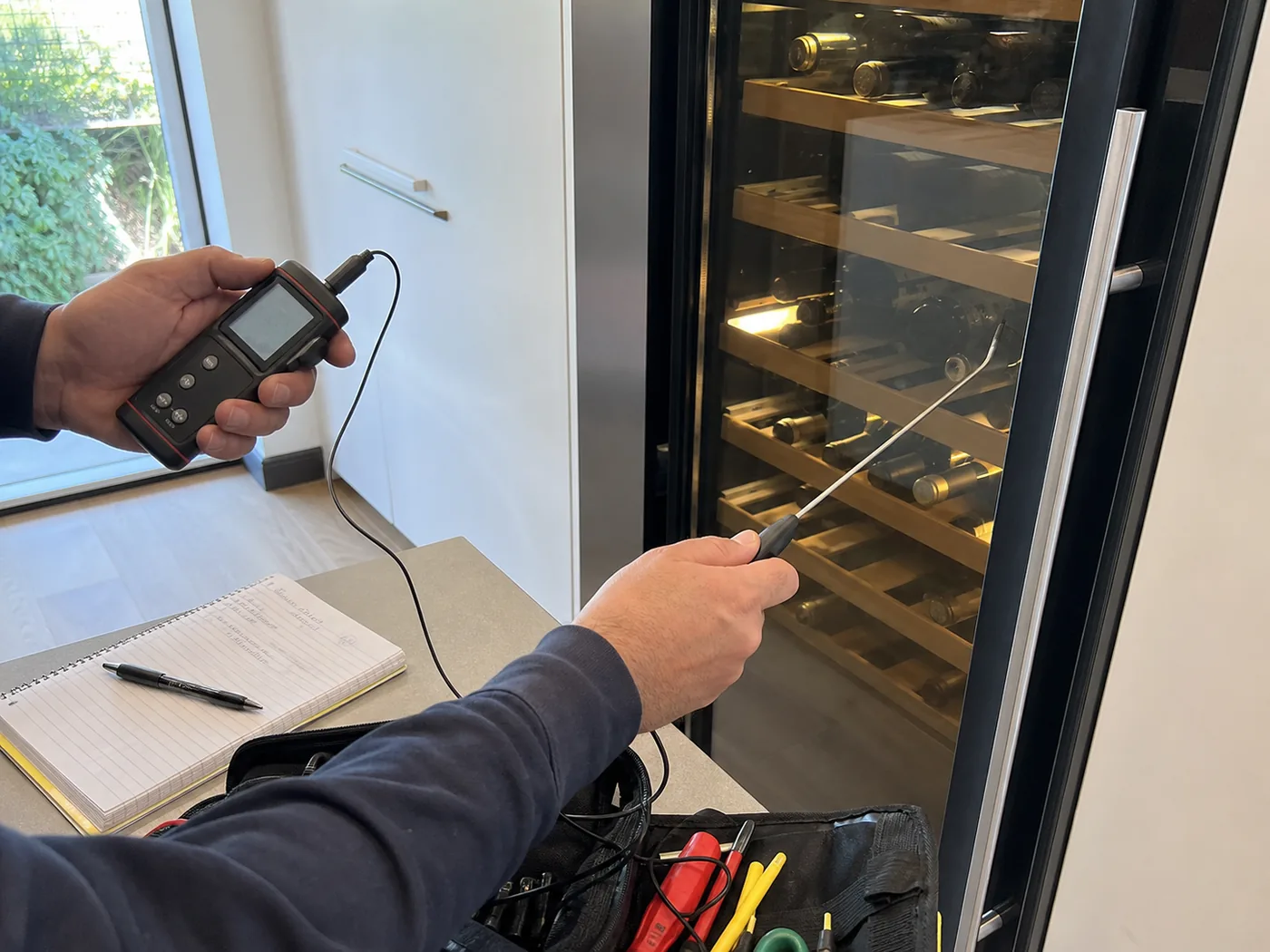
A Sub-Zero wine unit has a harder job than a refrigerator: it has to hold a narrow band of temperature and humidity, steadily, for years. In coastal Santa Cruz the surrounding air works against it from two directions — the cool damp of the marine layer pushing humidity up, and a heated cottage in winter pulling it back down.
That tug-of-war is most of what we see on wine-storage calls from the Westside out to Capitola and Aptos. Here is how to keep one honest.
Humidity is the part the coast complicates
A wine unit aims to hold humidity high enough that corks don't dry out, but not so high that labels mildew. On the foggy coast that balance is delicate. In summer the marine layer keeps ambient humidity high, and a door gasket that no longer seals cleanly lets that damp migrate inside, where you'll find it as condensation or a musty note when you open the door.
The fix is rarely the cooling system itself. Far more often it's the gasket, the door alignment, or a blocked drain that should be carrying condensate away. We check those first before anyone touches a sealed system — they explain most of the humidity complaints we trace in coastal cottages.
Temperature stability in a small kitchen
Many Santa Cruz homes — the Seabright bungalows, the Westside cottages, the older Capitola units near the water — have snug kitchens where a wine column sits close to a range or a sunny window. That nearby heat makes the unit's compressor cycle harder to hold its set point, and over time a strained compressor or a tired evaporator fan shows up as a unit that drifts warm by afternoon.
When we see a wine column that can't hold temperature, we read the actual numbers — set point, internal temperature, airflow, and fan operation — before recommending anything. A drifting unit in a hot corner is often a fan or an airflow problem, not the expensive repair owners fear. And to be clear, the wine column is a Sub-Zero product; Wolf, the sister brand, builds cooking equipment only.
FAQ
Questions & answers
My Sub-Zero wine unit smells musty in summer — is that the cooling system?
Usually not. A musty note in the foggy season most often points to a worn door gasket, a misaligned door, or a blocked condensate drain letting coastal humidity in. We check those before going anywhere near the sealed system.
Does Wolf make a wine storage unit?
No. Wolf builds cooking equipment — ranges, ovens, cooktops and the like. Wine storage and built-in refrigeration are its sister brand Sub-Zero, which we service throughout Santa Cruz.
Guides
More Santa Cruz guides
Sub-Zero Dual Refrigeration Explained: One Warm, One Cold in Santa Cruz
Why every Sub-Zero built-in runs two sealed systems, how to tell a single-circuit failure from a shared cause, and what repair costs in Santa Cruz.
Read the guide → Condensation vs Leak · 5 minSub-Zero Sweating or Leaking in Santa Cruz? Coastal Condensation vs a Real Leak
Sub-Zero sweating in Santa Cruz? Marine-layer condensation gets mistaken for a leak. Learn to tell coastal sweat from a real drain or water-line leak.
Read the guide → Wine cooler repair · 6 minSub-Zero Wine Cooler Repair in Santa Cruz: why a dual-zone column drifts warm
A Sub-Zero wine column has to hold two temperatures at once against the Monterey Bay air. The faults behind warm drift in Santa Cruz — sensors, fans, condensers and the sealed system — and when repair beats replacement.
Read the guide →