Wolf Repair or replace · 4 min read
Wolf Oven Heating Element Replacement: Fix the Element or Replace the Oven?
Wolf oven heating element replacement: how to spot a failed bake, broil or convection element, what a built-in swap involves, and when to replace the oven.
Wolf oven heating element replacement is usually the right call: bake, broil and convection elements are wear parts, and a new element costs far less than tearing out a built-in oven. Whether a Wolf oven deserves the repair comes down to 4 questions: its age, which part failed, how often it has failed, and how hard the element is to reach.
How can you tell a Wolf oven element has failed?
A failed Wolf oven element shows up as slow preheating, pale or scorched baking, a burning smell or a tripped breaker.
The exposed Wolf broil element can be checked by eye: set the oven to broil for 2 minutes and look without touching. A healthy element glows evenly; a dark section, a blister or one white-hot spot marks a failure.
The bake element on many Wolf ovens hides beneath the porcelain floor, so a technician meters its terminals with the power off.
Is it really the element, or another Wolf part?
Wolf oven replacement parts often get ordered on guesswork. A Wolf element that tests good but stays cold points upstream: a control board relay that no longer closes, a temperature sensor, a high-limit or thermal fuse, or a burned wire terminal.
A Wolf relay stuck closed does the opposite, powering an element nonstop until even a brand-new replacement fails.
Does the age of a Wolf oven change the answer?
Age alone rarely rules out a Wolf element repair. On a Wolf oven under about 10 years old, a single failed element is almost always worth replacing.
Past roughly 15 years, inspect the whole Wolf oven before buying parts: a worn door gasket, a tired control board or chipped porcelain can turn one element into several repairs. Even then, replacing a built-in means matching the cutout, the 240-volt circuit and the cabinetry, so a sound older Wolf oven often still earns the repair.
Why does the same Wolf element keep failing?
One Wolf element failure after years of baking is ordinary wear; a second failure within 1 or 2 years is a symptom. Usual culprits are a sticking relay, a loose terminal that arcs, foil on the oven floor trapping heat over a hidden bake element, and frequent self-clean cycles.
Oceanfront homes on the Monterey Bay add one more: salt air and heavy marine-layer fog can corrode the spade terminals behind a Wolf oven until the connection burns. Corroded Wolf terminals get replaced along with the element, not reused.
What a built-in Wolf element swap involves
Every Wolf element job starts with the 240-volt breaker off and the model and serial number from the rating plate, usually visible with the door open.
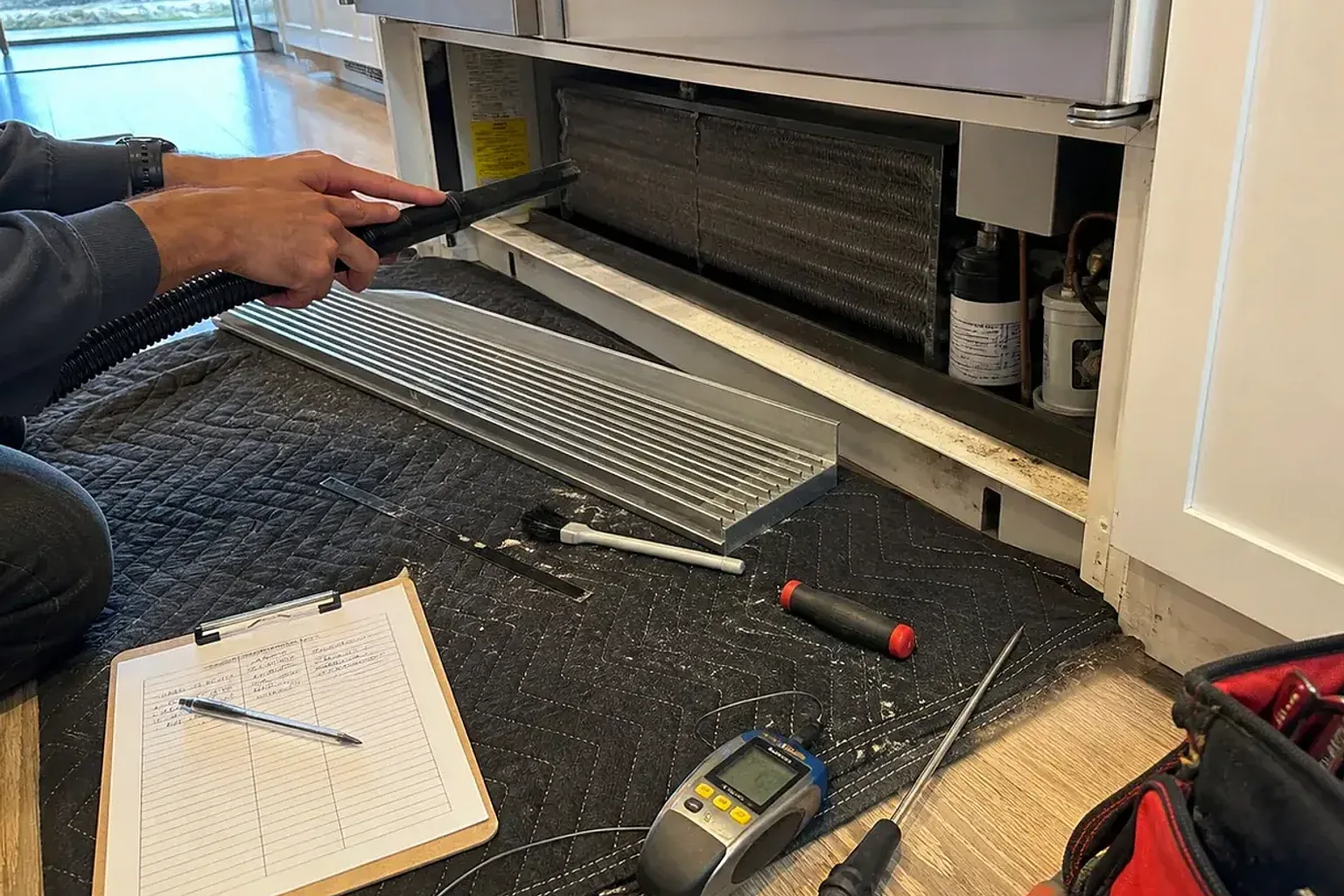
An exposed Wolf broil element is the simplest: a few screws come out, the element pulls forward, and the terminals unplug. A Wolf convection element sits behind the rear fan cover. A hidden Wolf bake element may mean removing panels beneath the cavity or sliding the oven out of its cabinet, a 2-person job.
Afterward, preheat the Wolf oven to 350°F and confirm with an oven thermometer.
FAQ
Questions & answers
Where do I get Wolf oven replacement parts?
Order Wolf oven replacement parts by the full model and serial number from the oven's rating plate. Use the genuine Wolf element listed for that model; a universal element may not match the mounting, terminals or wattage.
Can I replace a Wolf oven heating element myself?
Only the exposed broil element is a reasonable owner job, and only with the breaker off. Hidden bake and convection elements on a Wolf oven involve panels, wiring or pulling the built-in from its cabinet, which is technician work.
How long does a Wolf element replacement take?
An exposed Wolf broil element usually takes under an hour once the correct part is on hand. A hidden bake element takes longer, especially when the built-in Wolf oven has to come out of the cabinet.
What does a diagnostic visit cost?
The diagnostic visit is $234, credited toward the repair if you go ahead. The visit pins down the failed Wolf part before anything is ordered. Santa Cruz Sub-Zero Repair handles this locally — call (669) 304-2562.
Guides
More Santa Cruz guides
Sub-Zero Dual Refrigeration Explained: One Warm, One Cold in Santa Cruz
Why every Sub-Zero built-in runs two sealed systems, how to tell a single-circuit failure from a shared cause, and what repair costs in Santa Cruz.
Read the guide → Condensation vs Leak · 5 minSub-Zero Sweating or Leaking in Santa Cruz? Coastal Condensation vs a Real Leak
Sub-Zero sweating in Santa Cruz? Marine-layer condensation gets mistaken for a leak. Learn to tell coastal sweat from a real drain or water-line leak.
Read the guide → Wine cooler repair · 6 minSub-Zero Wine Cooler Repair in Santa Cruz: why a dual-zone column drifts warm
A Sub-Zero wine column has to hold two temperatures at once against the Monterey Bay air. The faults behind warm drift in Santa Cruz — sensors, fans, condensers and the sealed system — and when repair beats replacement.
Read the guide →| Usual verdict | Replace the failed element; bake, broil and convection elements are wear parts |
|---|---|
| DIY boundary | Exposed broil element with the breaker off; hidden bake and convection elements go to a technician |
| Repeat-failure red flag | A second failure within 1 or 2 years points to a relay, loose terminal or self-clean cause |
| Check after the swap | Preheat to 350°F and confirm with an oven thermometer |
| Who to call | Santa Cruz Sub-Zero Repair — (669) 304-2562 |
Book this repair: Santa Cruz Sub-Zero Repair Preparation Checklist · Sub-Zero Parts and Warranty Notes for Santa Cruz Repairs